


The Software-as-a-Service (SaaS) industry is evolving rapidly, and one trend is becoming impossible to ignore in 2026 — the rise of Vertical SaaS platforms. While traditional generic SaaS products once dominated the market with broad, general-purpose software platforms, modern businesses are increasingly shifting toward niche-focused solutions designed around specialized workflows, operational requirements, and user experiences.
From healthcare and fintech to logistics, eCommerce, real estate, and enterprise automation, Vertical SaaS is redefining how companies build, scale, and optimize digital operations. For developers, startups, enterprises, and product teams, this shift is creating new opportunities to develop smarter, faster, and more scalable software ecosystems.
As competition in the SaaS market intensifies, companies are increasingly prioritizing software that delivers industry-specific functionality instead of broad, one-size-fits-all platforms. This growing demand is fueling the rise of Vertical SaaS and reshaping the future of modern application development.
In this article, we’ll explore why Vertical SaaS platforms are growing faster than generic SaaS solutions and why specialized SaaS products are becoming the future of modern business infrastructure.
What Is Vertical SaaS?
Vertical SaaS refers to software platforms built specifically for a single industry or market segment. Unlike generic SaaS applications that serve a broad audience, Vertical SaaS products are designed around niche business workflows, regulations, customer expectations, and operational needs, focusing on solving highly specialized business problems.
Examples of Vertical SaaS Platforms:
- Healthcare management systems
- Fintech banking dashboards
- Restaurant POS platforms
- Legal case management software
- Real estate CRM solutions
- Logistics and supply chain platforms
- Construction project management systems
These platforms are designed with industry workflows, compliance requirements, reporting systems, and operational structures already integrated into the product experience.
This specialization creates stronger product-market fit and significantly improves usability for businesses operating within those industries.
The Difference Between Vertical SaaS and Generic SaaS
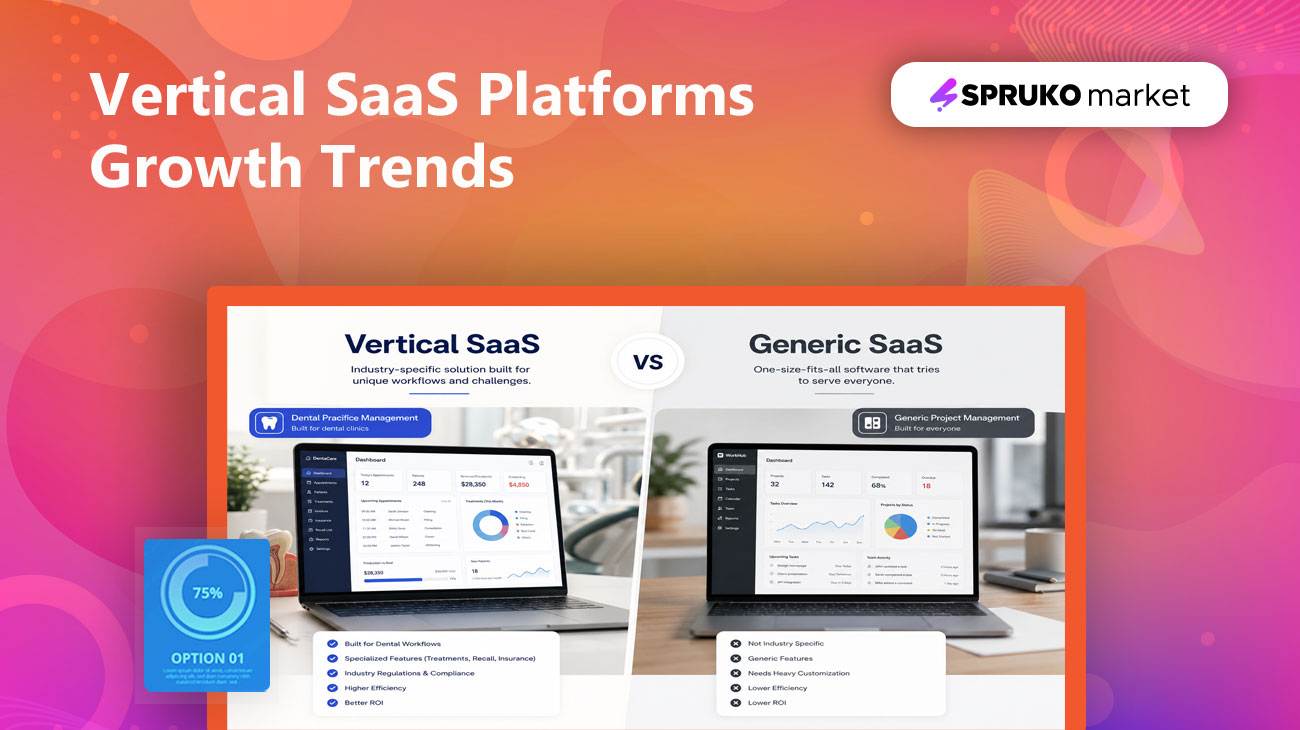
Traditional SaaS platforms are often built to work for many different industries using the same core product structure. While that flexibility can be useful, it also means businesses usually end up dealing with extra features they do not need, more complicated interfaces, and workflows that don’t fully match how their teams actually operate. In many cases, companies spend a significant amount of time customizing the software just to make it fit their daily processes.
Vertical SaaS takes a much more focused approach. Instead of trying to serve everyone, it is designed specifically for a particular industry. The platform is built around the real workflows, operational challenges, compliance requirements, and user expectations of that niche, making the overall experience more efficient, intuitive, and easier to adopt.
Vertical SaaS:
Vertical SaaS platforms are purpose-built for a specific industry such as healthcare, real estate, logistics, education, finance, or hospitality. These platforms are designed around industry workflows, allowing businesses to operate more efficiently with fewer customizations.
- Built specifically for a focused industry or niche market
- Provides industry-oriented dashboards and workflows
- Faster onboarding with reduced setup complexity
- Requires minimal third-party customization
- Supports industry regulations and compliance standards
- Offers deeper workflow automation and operational tools
- Improves customer retention through better workflow alignment
- Scales according to industry growth requirements
Generic SaaS:
Generic SaaS platforms are designed to support businesses across various industries using a broader feature set. While they offer flexibility and wide market reach, businesses often need additional customization, integrations, or workflow adjustments to match their operational requirements.
- Designed for businesses across multiple industries
- Uses generalized interfaces and universal workflows
- May require longer onboarding and employee training
- Often depends on plugins, integrations, or custom development
- Limited built-in support for compliance
- Provides broad automation rather than specialized workflows
- Faces stronger competition in crowded software markets
- Scales across a wide range of business environments
For many modern businesses, especially those operating in specialized industries, Vertical SaaS platforms offer a more efficient and practical solution by reducing operational friction and delivering tools that are already aligned with real-world business workflows.
Why Vertical SaaS Platforms Are Growing Faster
1. Industry-Specific Workflows Deliver Better Efficiency
Every industry has its own way of operating. The needs of a fintech platform are completely different from those of a healthcare, logistics, or real estate business. Using the same generic software structure for every industry often creates unnecessary complexity and workflow inefficiencies.
Vertical SaaS platforms solve this problem by delivering software built specifically around the needs of a particular industry. Instead of forcing businesses to customize everything manually, these platforms come with features and workflows already tailored to real-world operations.
This often includes:
- Pre-configured workflow architectures tailored to industry operations
- Specialized dashboards designed around real-world business activities
- Advanced reporting and analytics optimized for industry metrics
- Built-in compliance and regulatory management capabilities
- Intelligent automation for repetitive operational processes
- Role-based interfaces customized for specific organizational functions
Because the software is already aligned with industry requirements, businesses can reduce setup time, simplify operations, improve team productivity, and accelerate overall growth more efficiently.
2. AI Is Accelerating Vertical SaaS Adoption
Artificial intelligence is becoming a major growth driver behind the rise of Vertical SaaS platforms. Instead of relying on generic automation tools, businesses are increasingly adopting AI-powered solutions designed around their specific workflows, operational needs, and customer behavior.
Modern Vertical SaaS platforms now integrate advanced capabilities such as:
- AI copilots for faster decision-making
- Predictive analytics and forecasting
- Workflow automation for repetitive tasks
- AI-powered reporting and operational insights
- Intelligent customer behavior analysis
- Real-time operational recommendations
As AI adoption continues growing across modern software ecosystems, developers are increasingly using advanced AI development tools and AI coding assistants to accelerate SaaS product development, automate workflows, and improve overall engineering productivity.
What makes Vertical SaaS especially powerful is its ability to leverage specialized data rather than relying on broad, generalized datasets. This allows businesses to gain more accurate insights, smarter automation, and recommendations that better align with real-world operations.
For example, AI in healthcare platforms can improve patient scheduling and workflow management, while AI in logistics software can optimize delivery planning, route management, and inventory forecasting.
As businesses continue generating larger volumes of operational data, industry-focused AI is becoming a major competitive advantage, making Vertical SaaS platforms smarter, faster, and more valuable over time.
The Rise of AI-Native Vertical SaaS Platforms
One of the biggest technology trends shaping 2026 is the rise of AI-native SaaS applications.
Unlike traditional SaaS products, where AI features are added later, these AI-native platforms are based entirely on artificial intelligence from the start.
Examples include:
- AI healthcare diagnostics platforms
- AI-powered legal assistants
- AI fintech risk analysis systems
- AI logistics optimization platforms
- AI customer intelligence dashboards
These applications combine specialized workflows with intelligent automation, giving businesses a major competitive advantage.
Why Enterprises Prefer Vertical SaaS Solutions
Large enterprises are increasingly shifting away from generic software ecosystems that often demand extensive customization, complicated integrations, and long implementation timelines before they can effectively support business operations.
As industries become more data-driven and operationally complex, enterprises now prefer technology platforms that are already aligned with their workflows, compliance requirements, and organizational structure.
Vertical SaaS platforms deliver this advantage by providing:
- Faster onboarding and implementation processes
- Reduced operational complexity across teams
- Industry-focused analytics and reporting capabilities
- Lower employee training and adaptation requirements
- Built-in industry-ready architecture and workflows
- Simplified scalability for growing operational demands
For enterprises, this results in lower operational costs, improved productivity, faster digital transformation, and technology systems that integrate more naturally into real-world business environments.
The Role of Admin Dashboards in Vertical SaaS
In modern Vertical SaaS ecosystems, admin dashboards have evolved far beyond simple management interfaces. They now serve as the operational command center where businesses monitor performance, manage workflows, analyze data, automate processes, and make real-time operational decisions.
Whether it is a fintech analytics platform, healthcare management system, logistics operations panel, or enterprise CRM solution, dashboards play a critical role in transforming complex operational data into actionable business intelligence.
As Vertical SaaS platforms become more data-driven and AI-powered, businesses increasingly rely on intelligent dashboard systems to improve visibility, streamline operations, and scale more efficiently across departments and teams.
Essential Dashboard Features in Modern Vertical SaaS
- Real-time analytics and operational monitoring
- Multi-tenant architecture for scalable SaaS environments
- AI-powered insights and intelligent recommendation panels
- CRM and third-party platform integrations
- Workflow automation and process management systems
- Advanced financial reporting and revenue tracking
- Role-based user management and access control
- Predictive analytics and forecasting capabilities
- Modern dark mode interfaces and customizable UI experiences
- Fully responsive mobile and cross-device accessibility
For developers and startups building modern Vertical SaaS products, using professional admin dashboard templates, UI kits, and scalable SaaS interfaces can significantly speed up development while improving overall user experience and product scalability.
Modern dashboard frameworks also help teams simplify frontend architecture, maintain design consistency, and launch production-ready SaaS applications faster without building every interface component from scratch.
Why Developers Are Building More Vertical SaaS Products
For modern developers and startups, Vertical SaaS represents a significant opportunity to build scalable software businesses without competing directly in overcrowded generic SaaS markets. Instead of creating broad platforms that attempt to serve every industry, developers are increasingly focusing on specialized sectors with unique operational workflows, compliance requirements, and business challenges.
This industry-focused approach allows startups to create products with stronger product-market alignment, more practical real-world functionality, and higher long-term customer value.
Key Advantages for Developers and Startups:
- Easier Market Differentiation: Niche SaaS products are often easier to position and market because they solve highly specific industry problems rather than competing broadly against large multi-purpose platforms.
- Stronger Customer Retention: Sector-based software becomes deeply integrated into daily business operations, making it more valuable, harder to replace, and more effective at reducing customer churn.
- Higher Monetization Potential: Businesses are often willing to invest more in specialized software solutions that directly improve operational efficiency, automation, compliance management, and decision-making.
- Faster MVP and Product Development: Modern admin dashboard templates, SaaS starter kits, UI frameworks, and scalable frontend architectures allow developers to accelerate product launches without building every system from scratch.
As AI adoption, workflow automation, and industry-focused software demand continue to grow, Vertical SaaS is becoming one of the most attractive business models for developers building the next generation of scalable digital products.
Best Industries for Vertical SaaS in 2026
As businesses continue investing in automation, AI integration, and industry-focused digital transformation, several sectors are rapidly accelerating their adoption of Vertical SaaS platforms. These industries often require highly specialized workflows, operational processes, and compliance structures that generic software cannot efficiently support.
This growing demand is creating major opportunities for developers, startups, and SaaS companies building niche software solutions tailored to specific industries.
Fast-Growing Vertical SaaS Markets:
Healthcare Technology:
Healthcare organizations are increasingly adopting platforms for patient management, telemedicine, appointment automation, healthcare analytics, and compliance-focused operations.
Fintech Platforms:
Financial technology platforms continue growing through digital payments, AI-driven risk analysis, fraud detection, automated financial reporting, and banking automation systems.
AI Marketing Automation:
Businesses are investing heavily in AI-powered marketing platforms for customer engagement, campaign optimization, predictive targeting, and intelligent analytics.
Logistics & Supply Chain:
Logistics platforms now rely on route optimization, fleet tracking, warehouse automation, inventory forecasting, and real-time operational monitoring systems.
LegalTech:
Legal software platforms are modernizing case management, document automation, compliance tracking, contract workflows, and AI-assisted legal operations.
EdTech Platforms:
Education-focused SaaS products continue expanding through learning management systems, virtual classrooms, student analytics, and AI-powered educational tools.
Construction Management:
Construction businesses increasingly use software for project tracking, workforce coordination, budgeting, reporting, and field operation management.
Creator Economy Platforms:
Creator-focused SaaS platforms are growing rapidly through subscription management, monetization tools, creator analytics, digital asset management, and audience engagement systems.
Real Estate Technology:
Real estate businesses rely on specialized software for property management, listing automation, customer relationship management, tenant operations, and investment analytics.
Restaurant & Hospitality Software:
Hospitality platforms now support reservation systems, POS management, inventory tracking, customer analytics, delivery operations, and workflow automation.
As operational complexity and AI adoption continue increasing across industries, Vertical SaaS platforms are becoming the preferred solution for businesses seeking scalable, industry-optimized software ecosystems.
Design Trends Shaping Vertical SaaS Platforms
Modern Vertical SaaS platforms are evolving beyond traditional admin dashboards. In 2026, businesses expect faster, cleaner, and more intelligent user experiences that simplify workflows and improve productivity.
Popular UI & UX Trends in 2026:
- Minimal and distraction-free dashboard layouts
- AI assistant and copilot integrations
- Conversational and natural language interfaces
- Advanced analytics and real-time reporting widgets
- Dynamic personalization and smart recommendations
- AI-powered search experiences
- Glassmorphism and multi-theme dashboard designs
- Accessibility-focused and responsive interfaces
- Real-time collaboration and shared workflow systems
Developers and designers are increasingly prioritizing user-centric SaaS experiences that reduce complexity while improving operational efficiency and usability.
For developers and product companies, Vertical SaaS offers a major advantage by making it easier to build highly targeted products with stronger product-market fit. By focusing on a specific industry, teams can accelerate MVP development, prioritize features more effectively, gather more relevant user feedback, improve monetization opportunities, increase conversion rates, and reduce customer churn. This focused approach helps businesses build more meaningful, scalable, and competitive software solutions over the long term.
The Future of Vertical SaaS
The future of SaaS is becoming increasingly specialized, intelligent, and AI-driven.
As businesses demand:
- Deeper automation
- Industry-specific workflows
- Predictive analytics
- Personalized experiences
- Greater operational efficiency
Vertical SaaS platforms will continue outperforming generic alternatives.
For developers, designers, startups, enterprises, and digital product companies, this represents one of the biggest opportunities in modern software development.
Companies that build specialized ecosystems around real business problems will dominate the next generation of SaaS innovation.
Final Thoughts
Vertical SaaS platforms are growing faster because businesses now expect software tailored to their industry, workflows, and operational challenges. Combined with AI, automation, and modern dashboard technologies, Vertical SaaS is reshaping how digital products are designed, deployed, and scaled across modern industries.
For developers and SaaS companies, building specialized solutions is no longer just a niche strategy — it is becoming the future of competitive software development.
As industries continue demanding smarter, more focused platforms, the companies investing in scalable SaaS dashboards, intelligent workflows, and user experiences will lead the next generation of digital transformation.
Platforms like SprukoMarket are helping support this growing ecosystem by providing admin dashboard templates, UI kits, SaaS interfaces, and development resources that accelerate the creation of modern Vertical SaaS applications.
Whether you’re building a fintech platform, healthcare system, logistics dashboard, or enterprise SaaS application, choosing the right development foundation can significantly accelerate your growth journey.
