


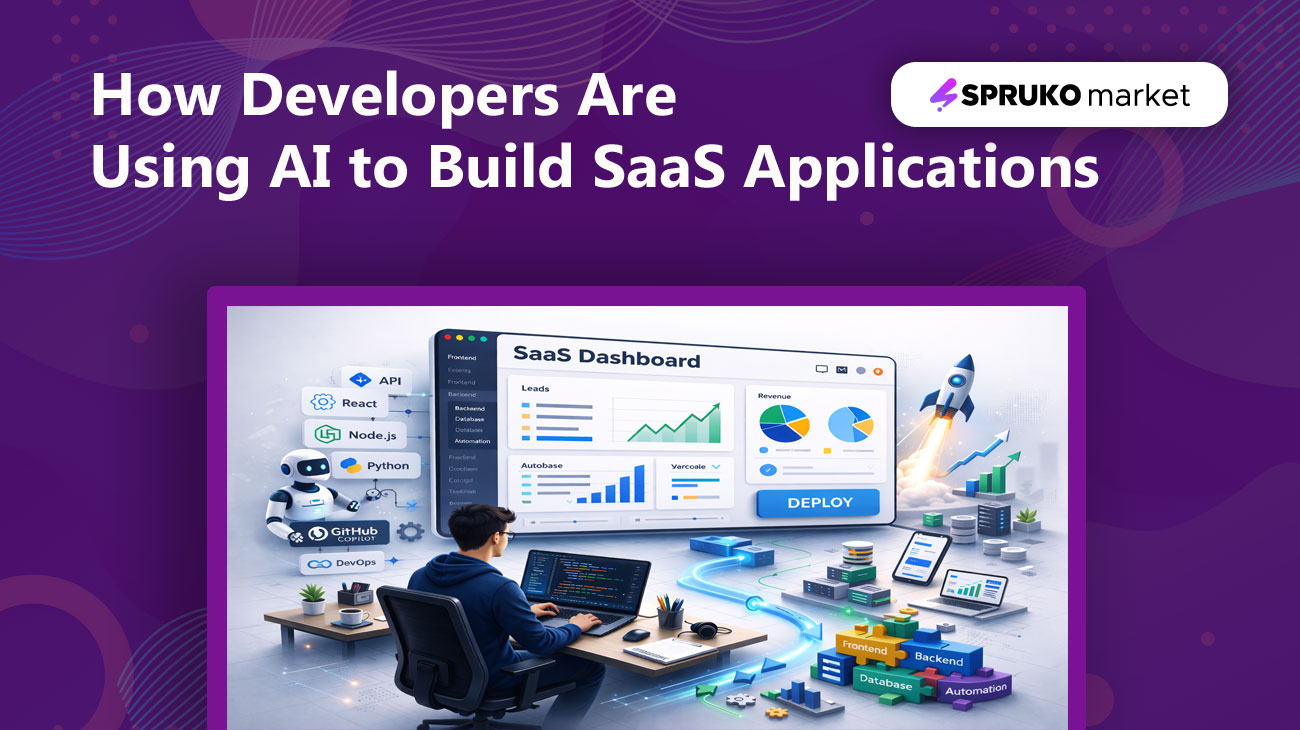
In the current technological landscape, almost every industry—from small businesses to large enterprises—is leveraging Artificial Intelligence to enhance productivity, generate better business outcomes, and increase revenue. In such an environment, learning and adopting AI has become one of the most valuable ways to improve skills, optimize workflows, and remain competitive.
In the software development industry, building digital products previously required months of development time, large engineering teams, and extensive resources. However, with the shift toward the AI-driven generative ecosystem, this landscape has significantly transformed. Today, developers can build websites and SaaS products much faster than before, often completing projects in weeks or even days.
The primary driving force behind this rapid transformation is Artificial Intelligence, which is redefining how modern software is designed, developed, and delivered.
Modern AI tools are no longer limited to simply assisting developers; they are fundamentally transforming how software is designed, developed, deployed, and maintained. From intelligent code generation and automated debugging to AI-driven UI creation and advanced testing automation, these technologies are enabling developers to work faster while maintaining high standards of quality and efficiency.
As a result, the SaaS ecosystem is experiencing a major shift. Today, many successful SaaS products are being developed by small, highly efficient teams—or even individual developers—who leverage AI tools to significantly accelerate the entire development process.
In this article, we will explore how developers and designers are using AI to build SaaS products more efficiently, the key tools that are driving this transformation, and the modern development workflows that are redefining the future of SaaS engineering.
The Evolution of SaaS Development
In the traditional software development model, building a SaaS product required collaboration across multiple specialized roles. These typically included:
- Backend Developers
- Frontend Engineers
- DevOps Specialists
- QA Engineers
- UI/UX Designers
- Technical Writers
Traditionally, building a scalable SaaS platform required six to twelve months of development before the first launch. The process involved significant resource investment, collaboration among specialized teams, and extended development timelines.Today, however, AI-powered tools are dramatically reshaping this timeline.
Modern developers can now:
- Generate production-ready code with AI assistance
- Automate repetitive and time-consuming development tasks
- Instantly create and refine UI components
- Detect and resolve bugs more efficiently
- Deploy infrastructure and manage environments automatically
Consequently, the software industry is entering a new paradigm known as AI-assisted engineering, where intelligent systems augment developer productivity, accelerating development cycles, reducing team size requirements, and enabling more efficient product delivery.
How AI Coding Assistants Are Transforming Modern Development
One of the most significant productivity breakthroughs in modern software engineering comes from the rise of AI-powered coding assistants. These tools are redefining how developers write, review, and optimize code throughout the development lifecycle.
Platforms such as GitHub Copilot and ChatGPT can now generate functional code, explain complex programming logic, and recommend optimized implementations in real time. Rather than acting as simple autocomplete tools, these AI systems function as intelligent development partners that enhance developer productivity and efficiency.
Curious about which AI tools developers are using today? Don’t miss our complete guide on “20 Best AI Coding Assistant Tools for Developers in 2026.”
With the support of AI coding assistants, developers can now:
- Instantly generate boilerplate code
- Create API endpoints and service integrations
- Refactor and modernize legacy codebases
- Transform pseudocode or conceptual ideas into working programs
- Identify, analyze, and debug complex issues more efficiently
For SaaS developers, this shift has a profound impact on development speed and workflow efficiency. Tasks that once required hours of manual coding—such as implementing standard CRUD operations, authentication flows, or repetitive backend logic—can now be completed in minutes.
As a result, developers are able to redirect their focus toward higher-value activities such as product innovation, system architecture, and delivering meaningful features that improve the overall user experience.
How AI-Powered Development Environments Are Transforming Developer Productivity
The next major leap in developer productivity is emerging through AI-native development environments. Unlike traditional tools that rely on external plugins or standalone assistants, these modern environments embed artificial intelligence directly into the core development workflow.
Editors such as Cursor IDE integrate AI capabilities seamlessly within the coding interface, allowing developers to interact with their codebase in far more intelligent and efficient ways.
With AI deeply integrated into the development environment, developers can:
- Generate complete functions or modules from natural language prompts
- Refactor large codebases or complex files with minimal effort
- Automatically generate clear and structured documentation
- Detect potential performance bottlenecks and optimization opportunities
In this new paradigm, AI is no longer just an external helper—it becomes a collaborative component of the development process itself. By understanding context across the codebase and assisting with complex tasks in real time, these environments significantly reduce the cognitive load developers face when building sophisticated SaaS applications.
As a result, developers can focus more on system architecture, product innovation, and solving meaningful problems rather than getting slowed down by repetitive or time-consuming development tasks.
Rapid UI Development With AI
User interface development has traditionally required close collaboration between UI/UX designers and frontend engineers. Designing responsive layouts, building reusable components, and ensuring a consistent user experience often demanded significant time and specialized expertise.
Today, however, AI-powered design and development tools are transforming this process. Modern AI systems enable developers to generate complete UI components and layouts directly from natural language prompts.
For example, a developer can simply describe an interface such as:
"Create a responsive SaaS dashboard with analytics charts and sidebar navigation."
Within seconds, AI tools can generate:
- Fully functional React components
- Tailwind-based UI layouts and styling
- Pre-structured dashboard templates
- High-quality landing page designs
This capability dramatically accelerates the UI development workflow. Instead of spending days manually designing and implementing interfaces, developers can now prototype and iterate on SaaS user interfaces within minutes.
As a result, product teams gain the ability to experiment with new ideas more rapidly, validate concepts earlier, and deliver polished user experiences at a much faster pace.
How Backend Development Is Becoming Automated
Artificial intelligence is not only transforming frontend development but is also reshaping backend development. With the help of AI-powered tools, developers can now easily generate complete backend structures. This includes automatically creating essential components such as API routes, authentication systems, database models, data validation logic, and standard CRUD operations. By automating these foundational elements, developers can significantly reduce the time spent on repetitive backend setup and focus more on building core product features and improving overall application functionality.
Many SaaS developers are increasingly leveraging AI-powered tools to build the initial backend architectures using popular frameworks such as Node.js, Django, FastAPI, and Laravel. These intelligent systems assist in generating well-structured, clean, and maintainable backend code, significantly reducing the time spent on repetitive development tasks. By automating foundational backend setup and common engineering patterns, AI enables developers to focus more on building core product functionality and delivering value to users. This approach is particularly beneficial for solo founders and small teams developing micro-SaaS products, as it allows them to build scalable backend systems efficiently without requiring large engineering resources.
AI Is Accelerating SaaS Debugging
Debugging has traditionally been one of the most time-consuming aspects of software development, often requiring developers to spend significant time tracing errors, reviewing documentation, and searching through community forums to identify the root cause of issues.
Today, AI-powered tools are transforming this process by enabling developers to analyze codebases and detect problems far more efficiently. Modern AI systems can quickly interpret error messages, understand the surrounding code context, and provide meaningful insights into what went wrong.
For example, developers can simply paste an error message into an AI assistant tool and instantly receive:
- A clear explanation of the underlying issue
- Suggested solutions and best practices
- Corrected or optimized code snippets
This capability significantly shortens the debugging cycle. Instead of spending hours investigating problems across multiple resources, developers can resolve issues almost immediately, allowing them to maintain development momentum and focus on building product features.
Automated Testing With AI
Testing is a critical component of building reliable and scalable SaaS applications. However, manually writing and maintaining test cases can be time-consuming and often slows down the development process.
AI-powered tools are now transforming software testing by automatically generating various types of test cases, including:
- Unit tests
- Integration tests
- Edge-case scenarios
Developers can simply provide a function, module, or API endpoint, and AI systems can analyze the logic to generate comprehensive test coverage. These tools help identify potential edge cases and ensure that different components of the application behave as expected.
By automating much of the testing workflow, AI enables development teams to improve product reliability and maintain higher code quality without increasing the overall development workload. This allows developers to focus more on building new features while ensuring that their applications remain stable and well-tested.
AI Is Streamlining SaaS Deployment
Deploying modern SaaS applications has traditionally required careful configuration of infrastructure, deployment pipelines, and performance optimizations. Managing these processes manually often demanded significant DevOps expertise and time.
Today, however, the emergence of advanced deployment platforms and AI-powered tools is simplifying and accelerating this process. Platforms such as Vercel, combined with intelligent AI assistance, allow developers to automate many aspects of the deployment workflow.
With the help of AI, developers can now:
- Configure and optimize deployment scripts
- Improve application performance and resource utilization
- Diagnose and resolve build or deployment failures more efficiently
- Automate CI/CD pipelines for continuous integration and delivery
By streamlining these critical processes, AI enables developers to deploy SaaS applications more rapidly while maintaining reliability, scalability, and high performance. As a result, teams can focus more on product development and innovation rather than managing complex deployment infrastructure.
How Are Solo Developers Building SaaS Businesses?
One of the most remarkable outcomes of AI-assisted development is the growing rise of solo SaaS founders. What once required large engineering teams and significant financial resources can now be accomplished by individual developers leveraging modern AI tools.
Today, developers are able to independently build and launch complete SaaS products by combining technologies such as:
- AI coding assistants
- Automated infrastructure and deployment platforms
- AI-generated UI and design systems
- AI-powered debugging and testing tools
These advancements have dramatically lowered the barrier to entry for launching technology startups. Tasks that previously required specialized teams across multiple disciplines can now be handled by a single developer supported by intelligent tools.
As a result, a new generation of indie developers and solo founders is emerging, building and scaling profitable SaaS products without the need for large engineering teams or extensive development resources.
The Future of AI-Driven SaaS Development
Artificial intelligence is rapidly evolving into a fundamental component of the modern software development lifecycle. As AI technologies continue to advance, their role in SaaS development will expand far beyond simple code assistance, becoming deeply integrated into every stage of the development process.
In the near future, we can expect innovations such as:
- Fully AI-generated application prototypes
- Automated system architecture planning and design
- AI-managed DevOps and deployment pipelines
- Self-healing software systems capable of detecting and resolving issues autonomously
Rather than replacing developers, AI is empowering them to work more efficiently and creatively, enabling the development of higher-quality software at a much faster pace.
Developers who embrace AI and learn how to integrate these technologies into their workflows will gain a significant competitive advantage in the rapidly evolving SaaS ecosystem.
Final Thoughts
Artificial intelligence is fundamentally transforming the way SaaS products are designed, developed, and delivered. What once required extensive time, resources, and large engineering teams can now be accomplished far more efficiently with the support of intelligent tools.
From code generation and UI design to automated testing and streamlined deployment, AI-powered solutions are enabling developers to work faster while still maintaining high standards of quality and reliability.
For startups, indie developers, and established engineering teams alike, AI-assisted development is no longer a luxury—it is rapidly becoming the new industry standard.
Developers and organizations that embrace AI today will be better positioned to build, launch, and scale SaaS products at a pace that was nearly impossible just a few years ago.
